
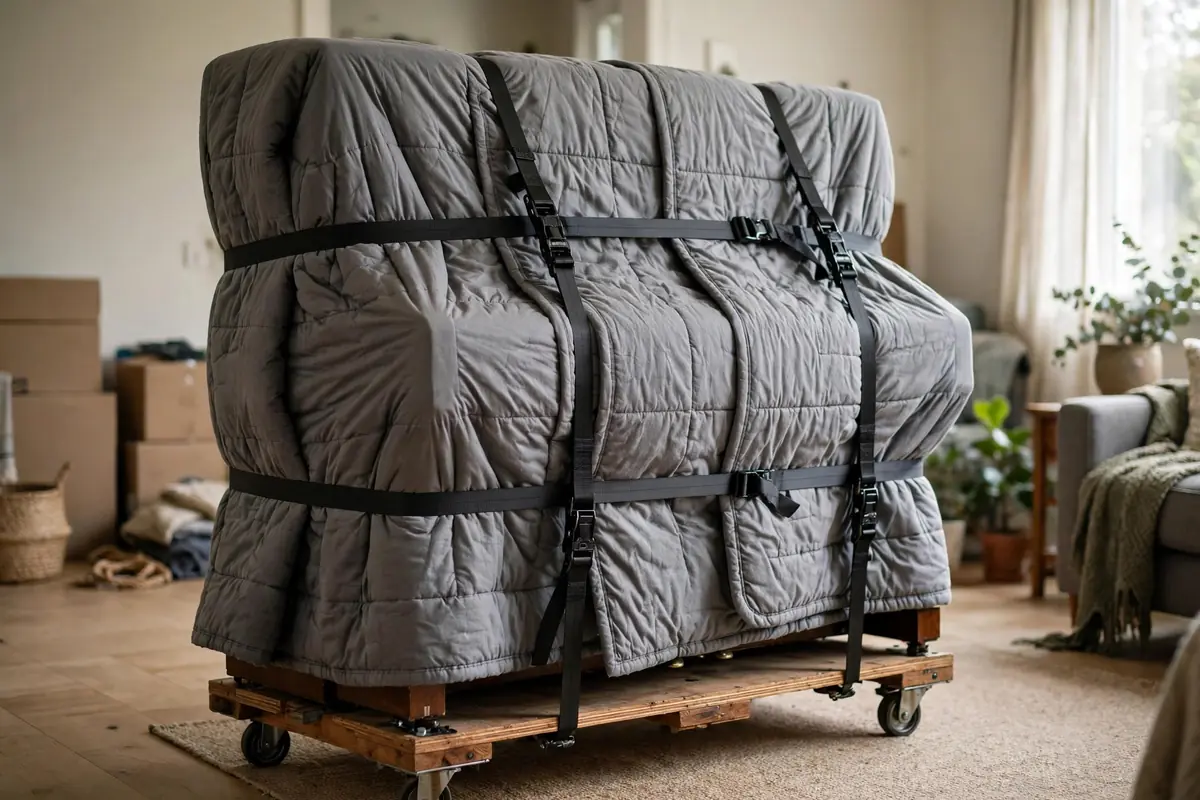
A piano is heavy, awkwardly shaped, and supported on small casters that concentrate its full weight onto tiny contact points. That combination is what damages floors: grit under a caster, a drag across hardwood, or a turn on an unprotected surface can leave marks that outlast the move.
This guide is general guidance, framed as questions to ask before you book. It makes no claim about any particular mover's piano capability, and it does not cover tuning or restoration, which are separate specialist matters to raise with a piano technician.
Why pianos damage floors
Three things combine to put floors at risk. First, weight: even a small upright piano is far heavier than any other single item in most rooms, and all of that weight rests on three or four casters. Second, grit: a single grain of sand trapped under a caster acts like sandpaper when the piano rolls. Third, movement method: dragging or pivoting a piano grinds casters into the finish, while lifting and rolling on protection spreads the load.
Hardwood, laminate, vinyl, and tile all react differently, and older finishes are generally more vulnerable than newer ones. The safe assumption for any floor is that it needs protection before the piano moves, not after the first mark appears.
Floor protection that helps
Protection works in layers: a clean path, a hard smooth surface to roll on, and soft padding where the piano rests or turns. In general terms, the materials used are protective floor coverings, hardboard sheets, moving blankets, and non-slip runners, chosen to suit the floor type and the route.
- Clean the entire route first. Sweep and mop the path so grit cannot get trapped under casters or boards.
- Cover the route with hardboard or protective sheeting before the piano moves, including turns and thresholds.
- Place moving blankets or padding under the piano whenever it rests, and at any point where it must turn.
- Protect door thresholds and transitions between floor types, where casters catch and floors chip most easily.
- Keep the path clear of rugs, cords, and loose items that can bunch under equipment.
Equipment to ask about
Piano moving uses equipment designed for the job. The central item is a piano board, also called a skid board, onto which the piano is secured with straps so it can be moved without rolling on its own casters. Dollies designed for pianos, ramps, and padding complete the usual set. Ask any mover what equipment they use for your piano type and your route, and how they protect floors along the way.
Upright and grand pianos are handled differently. Grand pianos generally require partial disassembly, including leg removal, by people experienced with that work, and reassembly at the destination. Ask who handles disassembly and reassembly, what it includes, and whether any part of it is referred to a specialist.
Stairs, turns, and tight spaces
Stairs change a piano move completely. Measure the full route in advance: stair width, landing sizes, turn angles, doorway widths, and ceiling heights. Count the steps, note whether stairs turn, and check whether the piano must go up or down. A route that looks passable on paper can fail at a single tight turn.
Ask how the crew approaches stairs, how many people will be on the job, and what happens if the planned route will not work. Ask about valuation and liability options for the piano specifically, since standard coverage may treat high-value items differently. Get the answers in writing before booking.
Questions to ask before you book
Piano moves reward specific questions. The research behind this guide recommends a "what to ask" approach for every specialty item, and pianos are the clearest case.
- Which piano types have you moved, and how do you handle uprights differently from grands?
- What equipment will you use for my piano and my route, including stairs?
- How do you protect floors along the entire route, including turns and thresholds?
- Who handles disassembly and reassembly, and what exactly does that include?
- What valuation or liability options apply to the piano, and what must be declared in advance?
- What happens if the route will not work on the day, and what alternatives exist?
- Will you survey the route in person or by video before the move?
Our specialty item moving page uses the same questions-first approach for pianos, pool tables, fine art, and appliances. For the estimate side, see why mover quotes change after the walkthrough.
Common mistakes that scratch floors
- Rolling a piano across unprotected hardwood, even for a short distance.
- Skipping the route clean, so grit grinds into the finish under casters or boards.
- Dragging or pivoting the piano instead of lifting it onto a board.
- Underestimating stairs, turns, or doorway widths until the piano is already moving.
- Attempting a piano move with too few people, which leads to rushed movements and lost control.
- Forgetting thresholds, where casters catch and floor edges chip.
When a piano move needs professional help
Any piano move involving stairs, a grand piano, a valuable instrument, or a tight route deserves a professional assessment before moving day. A route survey, in person or by video, is the point at which problems surface while they can still be solved.
Sugar Rush Moving is open 24 hours, every day. Call (317) 961-2712 to talk through your piano, your route, and the questions above. For Indianapolis-area background, see our Indianapolis location pages.
Frequently Asked Questions
How do you move a piano without damaging floors?
Clean the route, cover it with hardboard or protective sheeting, secure the piano to a piano board with straps, and never drag or roll it on unprotected floors. Ask any mover to describe their floor-protection method before booking.
What equipment is needed to move a piano?
A piano board or skid board, straps, padding, and dollies or ramps designed for pianos are the usual set. The right equipment depends on the piano type and the route, including stairs, so ask what will be used for your move.
Should I hire piano movers?
Consider professional help for stairs, grand pianos, valuable instruments, or tight routes. Ask about piano types handled, equipment, floor protection, and valuation options, and get the answers in writing.
Can you move a piano by yourself?
A piano should not be moved alone. The weight, shape, and caster pressure create injury risk and floor-damage risk, and control is easily lost on stairs or turns. Get enough experienced help for the piano and the route.
What should I ask about stairs when moving a piano?
Ask whether the route will be surveyed, how many people will handle stairs, what equipment will be used, and what happens if the route will not work. Measure stair width, landings, turns, and doorways in advance.
Get help with Moving and storage service in Indianapolis
Floor protection is the difference between a piano move and a floor repair. Clean the route, cover it, use a piano board, and ask the questions in this guide before anyone lifts anything.
Call Sugar Rush Moving at (317) 961-2712 any time. We are open 24 hours, every day.