
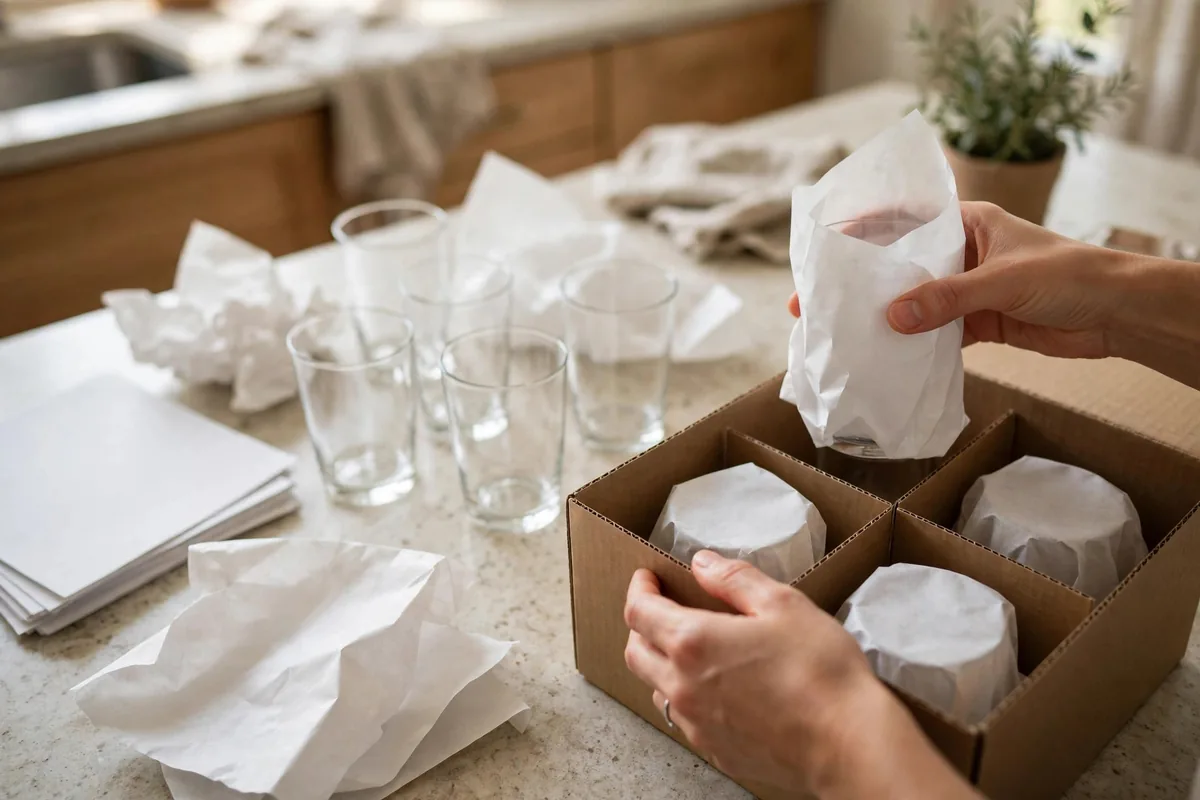
The kitchen holds a high concentration of fragile items: plates, bowls, glassware, ceramics, and small appliances, all in daily use until the last day. A local move does not make packing optional. Vibration, stacking, and sudden stops in the vehicle can break dishes however short the trip.
The method below is a simple sequence: sort, gather supplies, wrap each piece, cushion the box, and label clearly. No brand-name products are needed, and no step requires special equipment beyond sturdy boxes and packing materials.
The sequence: sort, gather, wrap, box, label
Work in this order, and the kitchen packs itself without last-day panic: sort and set aside what will not move, gather supplies, pack rarely used items first, leave daily essentials until the final day, and label every box as it is sealed.
- Sort: remove items that will not move, and set aside a first-night box of essentials.
- Gather: small sturdy boxes, packing paper, bubble wrap, tape, markers, and dividers.
- Wrap: every fragile piece individually, with no unwrapped item touching another.
- Box: cushion the bottom, layer pieces with padding between them, and fill gaps so nothing shifts.
- Label: room, contents, and fragile markings on at least two sides of each box.
Gather the right supplies before you touch a single plate
Small boxes are the most important supply. A large box full of dishes is too heavy to carry safely and crushes its own contents. Use small, sturdy boxes for dishes and glassware, and reserve larger boxes for light, unbreakable items.
- Small sturdy boxes, plus cell-divided boxes for glasses if available.
- Plain packing paper for wrapping, and bubble wrap for stemware and delicate pieces.
- Packing tape, markers, and labels for every box.
- Soft padding, such as towels or linens, for filling gaps and cushioning layers.
Avoid printed newspaper for wrapping: ink can transfer onto dishes and glassware. Plain packing paper avoids the problem entirely. For help with full, partial, or fragile-only packing in general terms, see our packing services page.
How to pack dishes for moving
Wrap each plate individually in packing paper, then stand plates on edge in the box, like records on a shelf, with a cushion of crumpled paper at the bottom and between layers. Plates are stronger on edge than flat, and stacked-flat piles concentrate weight on the bottom plate.
Bowls nest with paper between each one, and should not be packed rim-to-rim without padding. Fill every gap so nothing can shift, keep the box weight manageable, and tape the bottom securely before filling. A box that is hard to lift is overpacked: remove items rather than risking a dropped box.
Packing glassware: stemware, tumblers, and mugs
Stemware is the most fragile glassware in the kitchen. Wrap each glass individually, padding the stem and bowl separately, and stand glasses upright in cell-divided boxes where possible. Tumblers can be wrapped and placed upright with paper stuffed inside for support.
Mugs travel well with paper inside the cup and padding between handles. Wrap handles individually so they cannot chip against neighboring items. Label glassware boxes clearly, and keep them upright through loading and transport.
Small appliances, ceramics, and the odd-shaped stuff
Small appliances should be cleaned, dried, and packed with detachable parts wrapped separately and cords coiled and secured. Hollow items, such as vases and pitchers, can hold wrapped padding inside, but should never hold loose heavy items that can crack them from within.
Ceramics, serving pieces, and odd shapes need individual wrapping and generous padding, with the heaviest pieces at the bottom of the box and lighter pieces above. Knives should be wrapped individually with blades fully covered, packed blade-down in a clearly labeled bundle, and kept separate from other items.
Labeling and loading your fragile kitchen boxes
Label every fragile box with the room, a short contents note, and a fragile marking, on at least two sides and the top. Mark which side goes up where it matters. Labels decide how boxes are stacked in the vehicle and which boxes are unpacked first.
Load fragile kitchen boxes where they will not bear heavy weight, secured so they cannot slide or topple. Unpack the first-night kitchen box first: a few plates and cups, basic utensils, soap, towels, and whatever your household needs for the first morning. See our loading and unloading services page for general loading background, and our apartment moving page for kitchen packing in smaller spaces.
Common mistakes when packing fragile items
- Overfilling boxes until they are too heavy to carry safely.
- Wrapping several plates together instead of individually.
- Leaving gaps that let items shift and collide in transit.
- Mixing heavy items with fragile ones in the same box.
- Using printed newspaper that transfers ink onto dishes.
- Packing the whole kitchen on the last day, when rushing replaces wrapping.
When to get help with packing
Full packing, partial packing, and fragile-only packing are different scopes, and what each includes varies. Ask what packing help covers, how fragile items are handled, and whether unpacking and debris removal are included, before booking.
Sugar Rush Moving is open 24 hours, every day. Call (317) 961-2712 to talk through packing help for your kitchen and check availability.
Frequently Asked Questions
How do you pack fragile kitchen items for a local move?
Sort first, gather small sturdy boxes and packing materials, wrap every piece individually, cushion the box top and bottom, fill all gaps, and label clearly. Keep boxes light enough to carry safely.
How should I pack dishes for moving?
Wrap each plate individually in packing paper and stand plates on edge in a small box, with crumpled paper cushioning the bottom and between layers. Fill gaps so nothing shifts.
Should I use bubble wrap for kitchen items?
Bubble wrap is useful for stemware, delicate glassware, and ceramics. Plain packing paper works well for plates and bowls. Combining the two, with paper as the base layer, covers most kitchen items.
How far in advance should I pack my kitchen?
Start with rarely used items well ahead of moving day, and leave daily essentials until the final day. Packing a little each day beats packing the whole kitchen in one rushed session.
What goes in a first-night kitchen box?
A few plates, cups, and utensils, soap, towels, and whatever your household needs for the first morning. Label it clearly and load it where it can be reached first.
Get help with Moving and storage service in Indianapolis
Fragile kitchen packing rewards patience more than strength. Wrap each piece, cushion every box, keep boxes light, and label everything. The dishes that survive a local move are the ones that were packed as if the trip were much longer.
Call Sugar Rush Moving at (317) 961-2712 any time. We are open 24 hours, every day.